


Composable Architecture in 2026: Why Businesses Are Moving Away from Monolithic Software
In 2026, one of the biggest challenges companies face is adapting quickly to change whether it’s new customer demands, market shifts, or emerging technologies.
Traditional software systems, built as large monolithic applications, often struggle to keep up. Even small changes can require major redevelopment, slowing innovation and increasing costs.
To solve this, modern businesses are adopting a new approach:
Composable Architecture
This strategy focuses on building systems from smaller, independent components that can be easily combined, replaced, or scaled.
What Is Composable Architecture?
Composable architecture is a design approach where applications are built using modular, reusable building blocks.
Instead of one large system, you have multiple smaller components each responsible for a specific function connected through APIs.
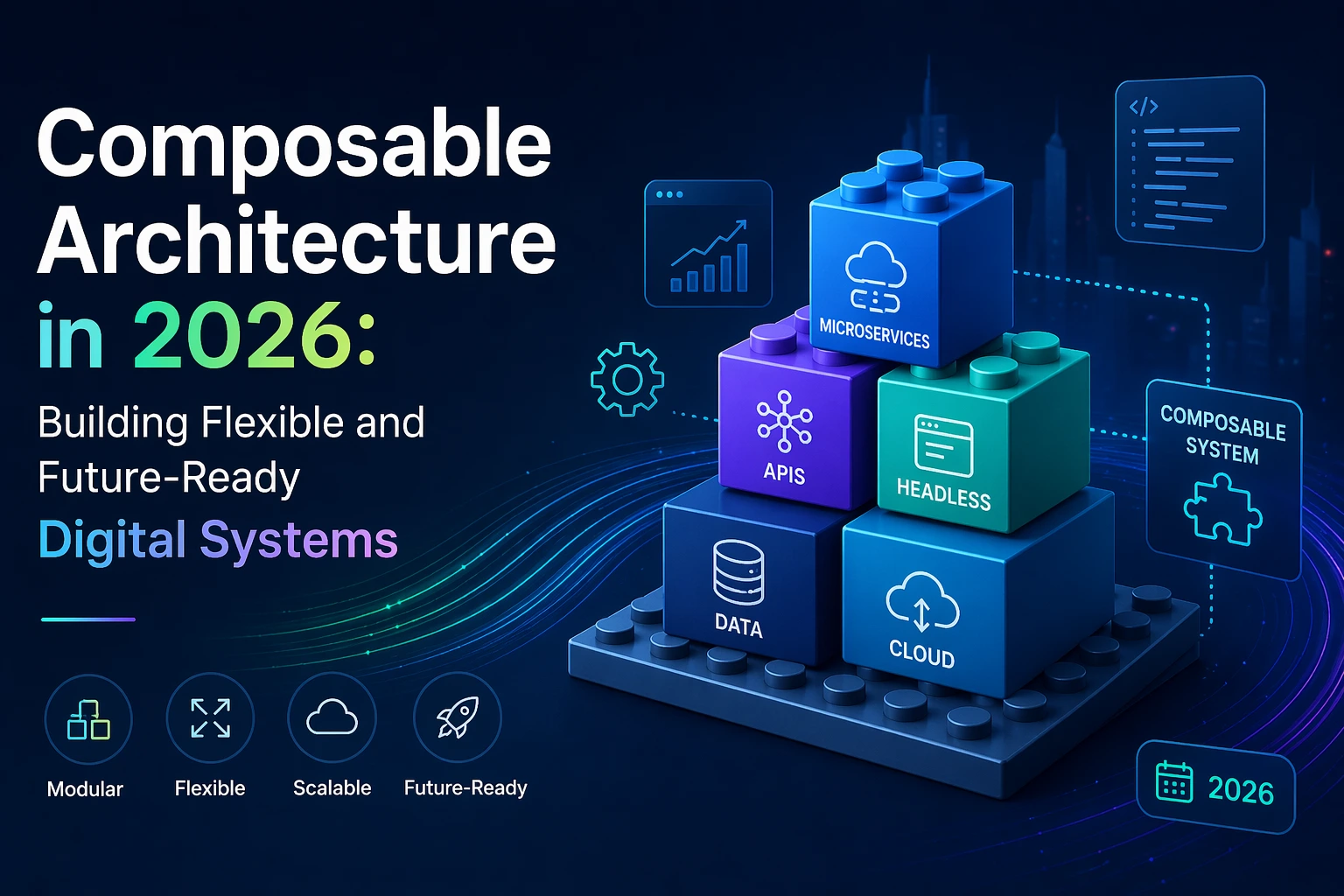
Think of it like LEGO blocks:
- Each block has a specific role
- You can rearrange or replace blocks easily
- The overall system remains flexible and scalable
Why Composable Architecture Is Trending in 2026
1. Need for Business Agility
Modern businesses must respond quickly to:
- Market changes
- Customer expectations
- Competitive pressure
Composable systems allow companies to launch new features faster without rebuilding the entire system.
2. Limitations of Monolithic Systems
- Slow development cycles
- High maintenance costs
- Difficulty scaling specific features
- Risk of system-wide failure
Even a small update can impact the entire application.
3. Rise of API-First Development
With API-driven systems becoming standard, businesses can connect different components seamlessly.
Technologies and tools like:
- Postman
- GraphQL
make it easier to build and manage composable systems.
Key Components of Composable Architecture
- Microservices: Independent services handling specific functions
- APIs: Connect different components
- Headless Systems: Frontend and backend separated for flexibility
- Cloud Infrastructure: Scalable and on-demand resources
Data Insight: Business Impact
Organizations adopting composable architecture are seeing:
- Faster time-to-market (up to 30–50%)
- Reduced development complexity
- Improved system scalability
- Lower long-term maintenance costs
Flexibility directly translates into business speed and efficiency.
Real-World Example
E-commerce Business:
Monolithic Approach:
- One system handles everything (UI, payments, inventory)
- Any update affects the whole system
Composable Approach:
- Separate services for payments, inventory, UI
- Each component can be updated independently
Result: Faster updates, better performance, and easier scaling
Benefits of Composable Architecture
- Flexibility: Easily replace or upgrade components
- Scalability: Scale only what is needed
- Faster Innovation: Launch new features quickly
- Reduced Risk: Failures are isolated, not system-wide
Challenges to Consider
- Requires strong architectural planning
- Increased system complexity
- Need for skilled development teams
However, long-term benefits outweigh the initial effort.
When Should Businesses Adopt This Approach?
- You want long-term scalability
- Your business requires frequent updates
- You operate across multiple platforms
- You are planning digital transformation
How Our Company Helps Build Composable Systems
At our company, we design modern, flexible architectures tailored to business needs.
Our services include:
- Composable system design
- API-first development
- Microservices architecture
- Cloud-native solutions
We help businesses build systems that are adaptable, scalable, and future-ready.
Final Thoughts
Composable architecture is not just a technical trend it’s a business strategy for agility and growth.
In 2026, companies that adopt this approach will:
- Respond faster to market changes
- Reduce development bottlenecks
- Scale without limitations
The future of software is not rigid, it’s modular, flexible, and composable.